Choosing the language of your degree is choosing the market your degree belongs to. A business degree taught 100% in English plugs into the international one. Here is the case — and its limits, because a school that hides trade-offs is selling, not teaching.
Four real advantages
Career reach
International companies, consultancies and startups work in English. A degree done entirely in English is three years of proof you can too.
The cohort
English-taught programs draw students from many countries. Your group-work partners are your first international network.
The materials
The discipline's cases, research and business press are written in English first. Studying in English means reading sources, not translations.
Mobility
Exchange, internship or first job abroad: everything is easier when your academic record is already in the language of the destination.
The honest trade-offs
If English is not your strongest language, the first semester costs more effort — lectures, readings and exams all draw on the same account. That is manageable when the school measures your level at entry and builds it daily, and painful when it doesn't. If you study in France, an English-only bubble is a real risk: you can spend three years in Lyon and leave with tourist French. LIBS answers the first with its measured English framework, and the second with free French classes for every student — the design assumes both problems exist.
Who it serves best
International students get a European degree without needing French first, in a country where daily life then teaches it to them. French students aiming at international careers get the credential markets actually check — sustained professional performance in English — without the cost of expatriation. Both sit in the same classroom, which is itself part of the training.
What English level do you need?
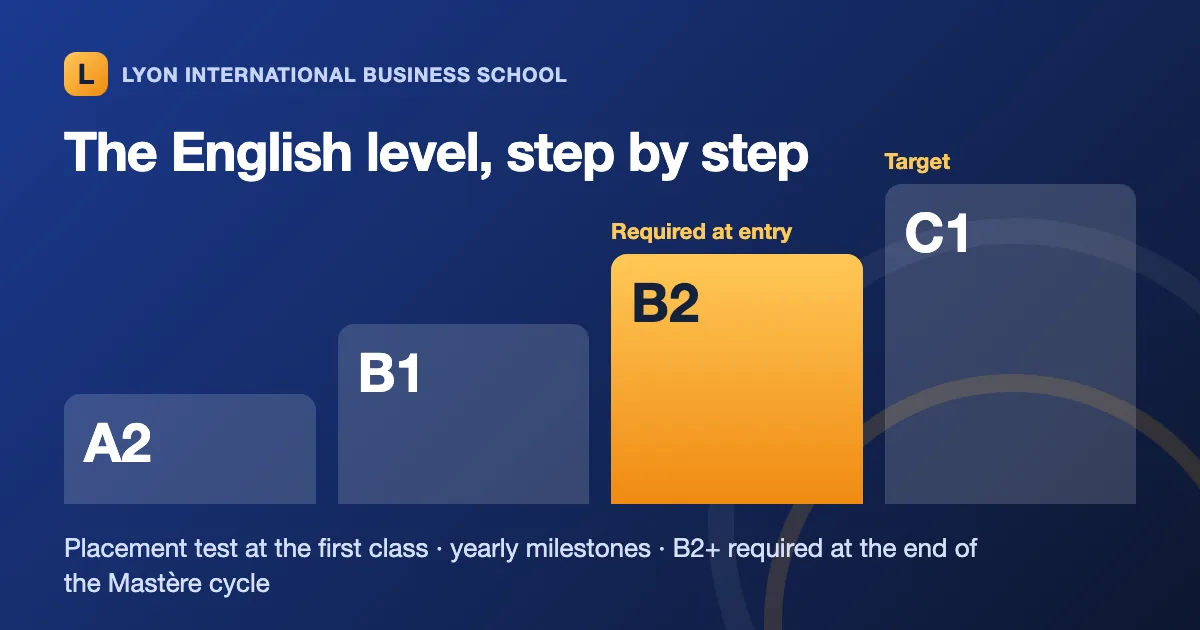
LIBS asks for CEFR B2 at entry, checked through the application and an interview. Once enrolled, a placement test is taken at the first class of each intake, a daily business English session runs Monday to Friday, and level is assessed again at year end. Preparation below B2 is a separate step from admission — your advisor explains it in writing.
Which English-taught program fits your profile?
After the baccalaureate: the three-year Bachelor (BBA-style). After a bachelor's degree: the two-year Mastère. With 3+ years of professional experience: the MBA in International Business & Management. Not sure? Compare MBA and Mastère or ask an advisor. LIBS belongs to Groupe École de Commerce de Lyon.
Frequently asked questions
Is a degree in English worth less in France?
French employers hiring for international roles treat verified English as an asset, not a discount. What matters is the diploma's terms — stated in writing at LIBS — and your actual level, which the framework measures.
Won't I miss French business culture?
You live in it: the campus is in central Lyon, internships and daily life are French, and FLE classes are free. The degree language and the life language complement each other.
Is 100% English really 100%?
Yes — lectures, coursework and exams. The free French classes and your chosen third language are additional tracks, not substitutes.
Related guides
The English business school in Lyon
Why this city, in this language.
The level you need
CEFR, translated into classroom reality.
Version française
Le cursus anglophone expliqué en français.
Talk to a LIBS advisor
Tell us where you are and where you want to study — you'll get answers in writing.