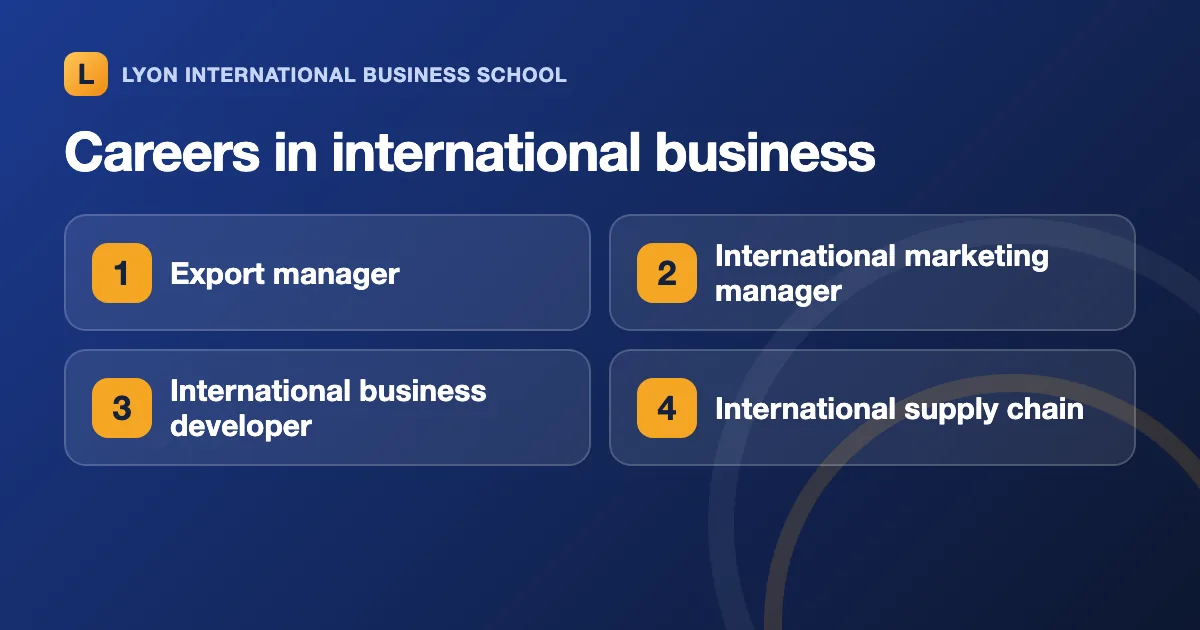
Supply chain is the most structurally short-staffed family of international business careers: purchasers, logistics coordinators, supply planners, customs specialists, supply chain managers. Less glamorous on Instagram than marketing — and often faster to responsibility.
The roles, mapped
| Role | What you actually do |
|---|---|
| International buyer | Source suppliers worldwide, negotiate cost/quality/lead-time, manage the relationship. |
| Logistics coordinator | Make goods move: transport modes, customs, documentation, incidents at 2 a.m. |
| Supply/demand planner | Forecast, balance stock against demand, keep factories fed and warehouses lean. |
| Supply chain manager | Own the whole flow end to end — the natural senior step of the family. |
Why it's a smart bet
Three structural winds: chronic talent shortage (published employer surveys have flagged supply chain among the hardest roles to fill for years), re-regionalisation of supply networks creating new European roles, and digitalisation that rewards young profiles fluent in data and English. Lyon specifically is one of France's main logistics hubs — internships are real here.
The study path
A business core (negotiation, operations, data) plus languages — supplier calls happen in English, factories answer in their own tongue. The LIBS Bachelor gives the international business base in English; the Mastère adds strategy and cross-cultural management; supply-chain-oriented internships and projects orient the profile. Say "supply chain" in your application and we'll map the path for your case — in writing.
Salary: the honest answer
Salaries in this career vary enormously by country, sector, company size and — above all — languages. We refuse to print a made-up "average": for France, consult the official published data of Apec (the executive employment association) for current figures by role and region; for other countries, use your national statistics agency or major published salary studies. What we can say honestly: at equal experience, verified professional English plus a second and third language raises both employability and pay in every published study we know — which is precisely the profile the LIBS cycle builds.
Frequently asked questions
Do I need an engineering degree for supply chain?
No — the family has two doors: engineering (flows, tools) and business (purchasing, negotiation, management). Both hire; the business door values languages and negotiation, exactly what an international business degree trains.
Is the work travel-heavy?
Purchasing and supplier management travel seriously (factories, fairs, audits); planning roles less. You can steer your mix by role.
Why do you say it's 'in shortage'?
Employer surveys across Europe have ranked supply chain roles among the hardest to fill for years — check any recent published talent-shortage study; we cite the trend, not an invented number.
Can a first job be international immediately?
Often yes for purchasing/coordination in exporting companies — languages decide how fast borders open in your scope.
Build this career, in English, from Lyon
Bachelor then Mastère in international business — tell us your plan, get a written answer.