“International business” is not a job title — it is a family of careers that share one requirement: operating professionally across borders and languages. Here is the honest map of where the LIBS cycle points.
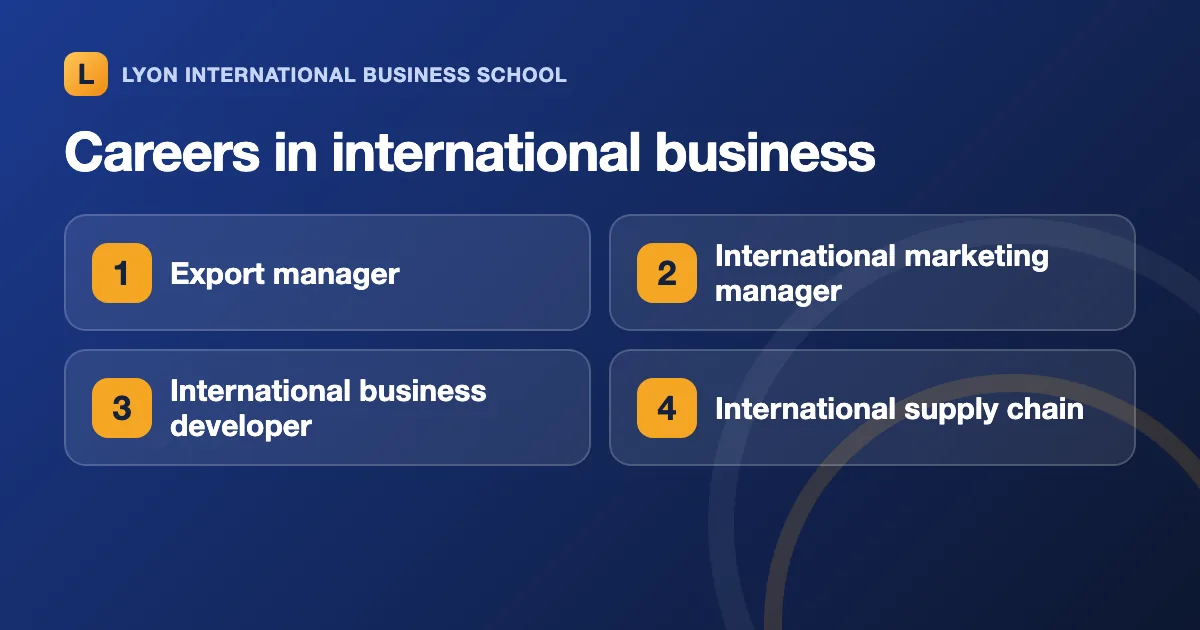
The role families
International sales & business development
Export management, key accounts, market entry — the classic first door, and the one where languages pay immediately.
Marketing across markets
International product marketing, digital campaigns across countries, brand localisation — where the intercultural training shows.
Supply chain & operations
Purchasing, logistics coordination, international operations — Lyon's industrial and logistics fabric hires here constantly.
Management & entrepreneurship
Project and team management in international structures — or your own venture, built with the Mastère's entrepreneurship track.
What employers actually test
Four things, in practice: verified English (not a CV line — a conversation held under pressure, which is what the measured B2+/C1 framework exists to guarantee); a second and third language (French plus your chosen third language — the combination is rarer than either alone); proof of adaptation (studying abroad, or in a foreign-language cohort, is itself the proof); and concrete experience — internships, projects, student jobs that touch real markets.
Why a Lyon base serves the plan
Lyon is France's second economic hub, with international headquarters, industrial groups, logistics platforms and a dense startup scene — a job market big enough to hire, close enough to enter. Internships and student jobs during the cycle turn into references and networks; the city's cost of living lets you build them without financial suffocation.
How the cycle builds employability, year by year
The Bachelor lays the base — management, international marketing and trade, digital business — while languages compound daily. The Mastère then sharpens the profile: global strategy, negotiation, cross-cultural management, entrepreneurship. By the end, the pitch to an employer is not “I studied business” but “I operated for five years in an international, English-speaking professional environment — here is the evidence.”
Frequently asked questions
Do graduates work in France or abroad?
Both paths are open by design: French-based international roles (Lyon's market is real) or careers in your home region and beyond, with a European degree and verified languages.
Which sector pays best?
Honest answer: it varies by market and year, and any school quoting you one number is selling. What reliably raises outcomes is languages plus internships — the two levers the cycle maximises.
Does LIBS place students in jobs?
LIBS builds the employability levers — languages, internships, an international cohort, career guidance — and helps you use them. No serious school promises a job; we promise the toolkit and the support.
Related guides
Working while studying
Rights, realistic jobs, the honest arithmetic.
Mastère vs MBA vs MSc
Choosing the right graduate degree.
LIBS Observatory
Sourced data on international education.
Talk to a LIBS advisor
Tell us where you are and where you want to study — you'll get answers in writing.
Career guides, one by one
Export manager
The classic first great job of international trade.
International marketing manager
Same product, twelve markets, twelve stories.
Supply chain careers
The most short-staffed family — mapped role by role.
Business developer
The growth-hunter: entrepreneurship on a payroll.